Newborns undergoing hernia surgery in Adelaide’s southern suburbs are being given an alternative to general anaesthesia after an international pilot study found the new technique is safe and effective.
Because their little lungs aren’t yet fully developed, infants are at higher risk of developing respiratory complications when fitted with a breathing tube.
So to reduce those risks, Dr Fiona Taverner, a paediatric anaesthetist at Flinders Medical Centre, has developed a new, less invasive method.
Called the Baby CHiX method, it combines regional anaesthesia, oxygen delivered through the nose and sedation so that the babies can breathe through their own lungs and without the assistance of a machine when they are undergoing the procedure.
“Groin hernia surgery is the most common operation in babies,” Dr Taverner said.
“But general anaesthetic can pose challenges for little ones. There are concerns about how repeated exposure may affect brain development, especially in the earliest stages of life.”
What exactly is a hernia?
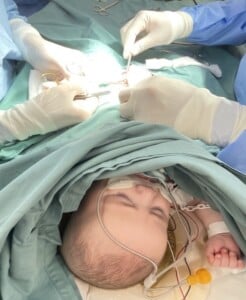
A newborn baby undergoing groin hernia surgery is given the new Baby CHiX method instead of general anaesthesia.
Groin hernias occur when part of the bowel pushes through a weak spot in the muscle wall and is common in premature babies, especially boys.
Surgery is always necessary as, if left untreated, there is a risk that the bowel could get stuck outside the wall, cutting off its blood supply.
Traditionally, this procedure uses full-body anaesthesia and a breathing tube, which can be riskier for babies, especially those born prematurely.
Trial shows positive signs
The international trial took place at three hospitals (two in South Australia and one in New Zealand) and involved 22 different doctors and anaesthetists.
Dr Taverner said 50 patients participated in the trial, with a success rate above 80%.
Her research is already making a real-world impact, and the technique is now being embraced by surgeons and neonatal teams across the Southern Adelaide Local Health Network (SALHN).
“Parents have been incredibly supportive of this project. They want the best and safest option for their babies, and this gives them that choice,” Dr Taverner said.
“We want to try and provide the best and safest possible care we can to our babies locally but also develop a technique that can be used or adapted to suit many babies looked after by different people nationally and globally.”
This project was made possible through funding from the 2022 SALHN Enquiry Grant Round, jointly supported by The Hospital Research Foundation Group and Flinders Foundation.
Thanks to this research, made possible by your donations, more babies in Adelaide and around the world will receive the best start to life!