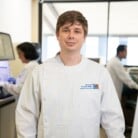
At just 21, living the dream at university and on the brink of realizing his career goal of becoming a qualified psychologist, Kilian Woulfe received some devastating news.
He said deep down, despite the diagnosis initially being missed by his GP, he knew that his body was beginning to fail him and that there was something seriously wrong.
“One of my first memories from that time was realizing on some level that it was cancer, despite the feedback from my GP at the time,” he explains.
“I knew within myself that the particular way my body was failing me matched what I knew about cancer from the elective human biology and medicine units I’d done as part of my course.
“It wasn’t truly conscious or clear at that stage and I tried to push it back down because the realization was obviously scary and clashed with my stubborn plans to finish my last exam and last week of work,” Kilian said.
It would be his last of both for quite some time for Kilian as he embarked on gruelling treatment for Acute Promyelocytic Leukaemia (APML), that, by the time he was ultimately diagnosed by doctors at Royal Perth Hospital, was significantly advanced and threatening his life.
“I was told that I had become so sick that I would have internally bled out within another 6-12 hours and that my heart was badly damaged.”
Kilian started aggressive treatment for APML in November 2013, at just 21.
Unable to have regular chemotherapy due to the damage the disease had already done to his heart, Kilian’s doctor and family made the decision to treat him with a targeted combination of all-trans retinoic acid (ATRA) and arsenic trioxide (ATO).
Kilian was one of the first in WA to receive this targeted treatment – one that would ultimately save his life, albeit leaving him with side effects that the now successful 33-year-old qualified clinical psychologist is still dealing with today.
However, at the time, Kilian’s life hung in the balance, with his whole family putting their lives on hold to ensure he had the best chance of survival.
“It was a really difficult time with my family, as on the one hand they made some enormous sacrifices I will never fully be able to acknowledge or repay to be with me through my treatment,” he says.
“However, on the other hand, when I was constantly in pain, cooped up and feeling unwell for so many months I became SUCH a short-
tempered grumpy bugger with them and it was really hard to break that cycle,” he says.
Reflecting on what would become a life-changing experience for them all, Kilian says that a lot of it boiled down to his whole world becoming saturated by illness where every conversation became about treatment, medication, pain ratings and endlessly being asked how you feel.
“Which became an embarrassingly strong trigger for me to get cranky as a result!”.
“The antidote to a lot of that was to really prioritise making time for the little positive things, like being allowed to travel home for a few days, seeing our dog, visits from friends and just silly things like my little brother teaching me Italian (but only the crude and rude parts),” he adds.
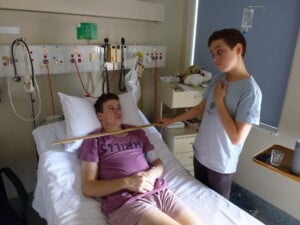
My other brother and father also did a great job of keeping me grounded and ‘normal’ by having non-illness related conversations and playing games with me as a welcome break.
“I like to think this still affects me in how much I appreciate the little things in life and also feedback from friends about my calmness in response to stress and setbacks.”
While his responses are both humble and humbling, it’s a grounding experience that he never wanted but admits has helped him in his career as a psychologist in terms of empathy and always trying to walk in someone else’s shoes.
“There was a moment that probably influenced me the most as a person and as a psychologist from one of my commutes into the hospital.”
He said he had become an outpatient but was still having nearly daily chemotherapy, which meant regular commutes on the train with mum Catherine by his side.
“One of these trips really stuck with me because I remember it had been a particularly rough patch with side effects of the treatment, including feeling like I was seconds from vomiting for days on end.
“Outwardly I didn’t necessarily look ‘sick’ but it was one of the worst days of my life and a time when I only had the energy to make it to the seats on the train near the door for people with mobility issues.
“I remember feeling very self-conscious about looks from people about using one of these seats and I think about that day a lot as a reminder to myself – now that I’m well again – how subtle someone’s worst day of their life can look.”
He says it’s a reminder to bring as much kindness and patience as he can into his everyday interactions with people .
.
He said one of his other great fears was his failing battle with ‘chemo brain’.
“For me, the scariest part of having cancer was never the thought of dying, it was initially the thought of how the people I would be leaving behind would feel, how they would cope with their pain.
“However, as I got through the first stage of treatment and started to allow myself to think of ‘after’, the scariest thing became the idea that the brain fog I had at the time would be at least semi-permanent and end my dream career in psychology.”
He says, thankfully, he was able to finish his studies and looks back with some humour on his repeated (and failed) attempts to read his academic textbooks (affectionately referred to as his ‘sleeping pill’ by the more familiar nurses).
Kilian said he couldn’t share his story without mentioning the amazing team he had in hospital.
“I was really lucky to have received such incredible support from everyone involved in my care at Royal Perth back then.”
Kilian said that with the support of his mum and the hospital social worker, he (foolishly in hindsight) was back in classes three days after finishing his final dose of chemotherapy rather than “languishing in my worries about how my brain was working”.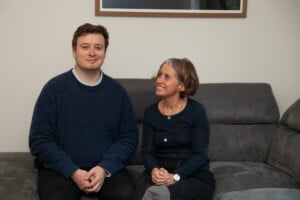
It also prompted mum Catherine, a researcher with Monash University, to advocate for families facing a similar journey. You can read more about Catherine’s journey here.