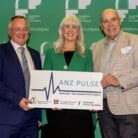
The Hospital Research Foundation Group recently joined honorary patron Professor Barry Marshall AC and Hon Stephen Dawson MLC, Minister for Science & Innovation and Medical Research, to celebrate two decades of health innovation at The University of Western Australia.
The evening also marked 20 years since Prof Marshall AC and the late Prof Robin Warren AC received the Nobel Prize in Physiology or Medicine – and Prof Marshall’s official retirement from what has been an outstanding, globally-recognised academic career.
Prof Marshall took to the stage with colleagues and band mates to mark the celebration and ensure his retirement was celebrating in truly unique style
Their remarkable achievement has become part of medical folklore and has impacted the way ulcer sufferers are treated across the globe.
 Seeking to prove that established conventional medical opinion at the time was wrong, junior physician Dr Barry Marshall AC, risked his life and swallowed a potentially harmful bacteria that would make him develop stomach ulcers before successfully treating himself with an antibiotic.
The move shocked the medical and broader community at the time but went on to earn he and his then supervisor, Emeritus Prof J. Robin Warren, the Nobel Prize for Medicine and Physiology.
In 1979, Dr Robin Warren, then a gastroenterologist at Royal Perth Hospital, was studying biopsy specimens of stomach ulcers. At the time, it was generally believed that bacteria couldn’t grow in the stomach because of the acidic environment and that ulcers were caused by bad diet, stress and alcohol.
However, Dr Warren took tissue from a patient with stomach ulcers and looked at them under the microscope noting the presence of masses of bacteria.
Two years later in 1981, Dr Marshall, then a junior medical resident, joined Dr Warren in the ongoing research into bacteria and ulcers at RPH, with the pair famously going on to prove the doubters in the medical community wrong and kickstarting their storied careers in medical research across the globe.
As records show, during the Easter holiday of 1982, the two doctors forgot to check on their samples for several days and when they returned to the laboratory, they noticed a profuse growth of slow growing spiral-shaped bacteria.
They named the bacteria Helicobacter pylori (H. pylori) and found that it was present in virtually all patients with gastritis and stomach ulcers that they had examined, leading them to propose that this was the cause rather than lifestyle factors.
Despite their claim being met with deep skepticism and even ridicule at the time, the pair persisted with their hypothesis and eventually proved it in a way that shocked the medical fraternity across the globe.
Dr Marshall swallowed 50ml of H. pylori and, as both suspected, developed nausea, vomiting, fever and chills leading to gastritis and stomach ulcers.
He then took a dose of antibiotics which went on to eliminate the bacteria, his stomach ulcers healed, proving gastritis and stomach ulcers were caused by bacteria, with the two doctors going on to publish their results in the Medical Journal of Australia.
The remarkable breakthrough, now part of medical folklore, earned Prof Marshall and Emeritus Prof J. Robin Warren a Nobel Prize in Physiology and Medicine 20 years ago in October this year and cemented both men’s reputations as global leaders in medical research.
Prof Marshall AC is an honorary patron of The Hospital Research Foundation Group in WA and alongside his wife Adrienne, continues to give back to young WA researchers via the Group’s Barry Marshall Travel Awards, which sponsor researchers to attend and present at conferences nationally and internationally – an opportunity he credits with kickstarting his remarkable career.
As well as being one of only 11 Australians to have received a Nobel Prize since 1915, Prof Marshall is a director of The Marshall Centre for Infectious Diseases Research and Training, a UWA Brand Ambassador and WA Ambassador for Life Sciences.