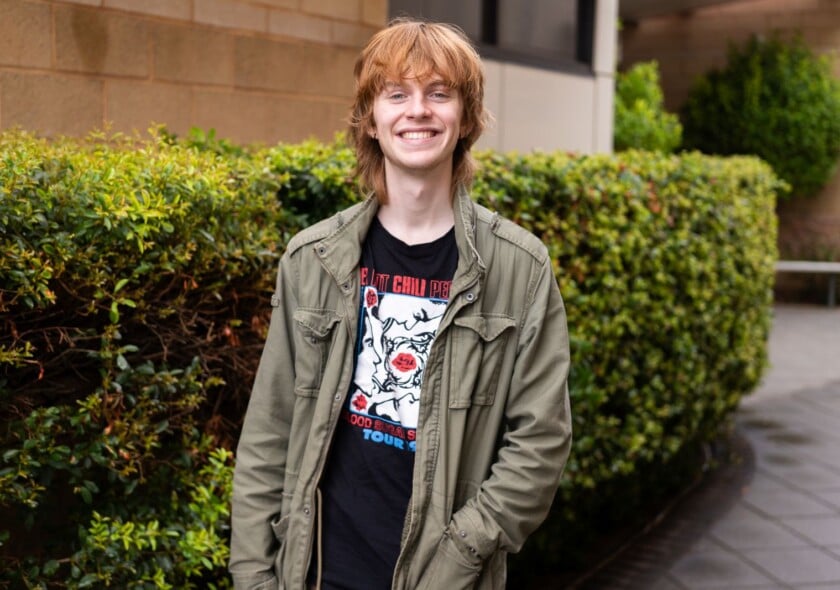
Ethan Andrews was like any other two-year-old, playing and running around on the playground when he started to develop pain in his ankles.
His parents were told it was simply a sprained ankle, an injury that normally takes about a couple of weeks to heal.
But months later, the pain was still there.
After pushing for more tests, Ethan was diagnosed with polyarticular juvenile idiopathic arthritis, an autoimmune condition meaning he has chronic pain in five or more joints – in his ankles, knees and elbows.
“When I get a flare up my joints can blow up really big and get hot, then I have to have some kind of steroid injection or tablet to help it subside,” Ethan, now 18, said.
“The pain kind of feels like a hot, aching feeling and when you put pressure on it, it becomes like a sharp pain.
“In my early years, I would try to be more active and then I’d end up in a wheelchair or hospital, so managing it was difficult.”
At three years old and after continued flare-ups that couldn’t be managed by oral steroids, Ethan began receiving injections of methotrexate.
Originally developed as a chemotherapy drug, methotrexate is also prescribed in small doses to treat autoimmune conditions and works to calm the immune system and stop the body from attacking its own cells.
Ethan eventually managed to wean off the drug and went into unmedicated remission after taking it for several years.
Six months later though, the condition came back with a vengeance, attacking his ankles, knees and optic nerve.
‘Isn’t that for old people’?
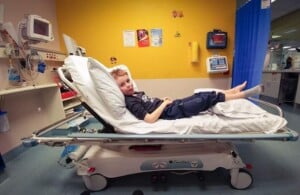
As a child, Ethan would often spend time in and out of hospital due to chronic pain associated with his juvenile arthritis.
Most people think of arthritis as an elderly person’s condition.
But as many as 10,000 young Australians live with juvenile arthritis, making it about as widespread as childhood diabetes.
Despite this prevalence, awareness of the condition amongst the general population is low.
A YouGov survey commissioned by Arthritis Australia in 2025 found that 63% of Australians believe arthritis only affects people aged 65 and above.
One in seven people also believe children and young adults aren’t affected by arthritis at all.
“People would say ‘arthritis, isn’t that for old people’ and I would have to explain, no kids can get it too,” Ethan said.
Living with an invisible illness means that for some kids the legitimacy of their condition can often be questioned.
Teachers and fellow students did not understand the condition, and comments like ‘you look alright to me’ or ‘you were fine yesterday’ were commonplace for Ethan.
Ethan said these perceptions impacted how he managed his condition growing up.
“There were obviously the people who thought I was faking it because they didn’t understand the idea of being in a wheelchair for a few days and then out after that,” he said.
“A lot of the adults, they saw me as some kind of strong, inspirational person but being always told that you are strong for dealing with everything you’re dealt, you feel like you can’t be down about your problems.
“From trying not to use your wheelchair as much because you don’t want people to think you’re faking it, to trying to deal with everything on your own because everyone perceives you as strong, it can change how you deal with the condition.”
Reclaiming his identity
Adolescence is a crucial period where a person begins to form parts of their identity, and previous studies have shown that juvenile arthritis can significantly impact how kids see themselves.
For Ethan, he was so intertwined with his pain that he almost became attached to it.
“It was to the point that, when I was going into remission and when I was finally getting over the chronic pain that I started to get worried and feel empty, like I lost part of my identity,” he said.
“It’s such a prevalent part of your life; the hospital trips, chronic pain, trying to monitor it all and it becomes this big part of your identity having to explain it to basically everyone.”
But instead of holding onto those experiences, the now-18-year-old is looking to channel them into a career where he can help others who are going through a similar journey.

Ethan spent time volunteering at Kidsflix, an event attended by other kids with juvenile arthritis run by The Hospital Research Foundation Group.
As a teen, complications following an injury to Ethan’s ankle left him facing the prospect of wearing a permanent leg brace to help stabilise the joint.
It was during this time that Ethan began to research nueroprosthetics, setting off a lightbulb for his future career aspirations.
“I’m doing at the moment a biomedical engineering and medical sciences degree in which I hope to make medical devices or look into potentially becoming a paediatric rheumatologist to help those with arthritis, especially the kids with arthritis,” he said.
“At the time of my injury I did a lot of research into prosthetics and neural interfacing prosthetics and now that’s the industry I’m looking at. So, biomedical engineering to develop prosthetics, and maybe even some things that could help with arthritis as well.”
“It is such a prevalent part of my life and that’s always going to be the case, so it’s taking that and making a positive experience out of it in order to retain that part of my identity without holding on to the negativity that came with it.”
Now in his first year at Flinders University, Ethan is in medicated remission and still lives with pain in his ankle but has self-management strategies for when a flare-up occurs.
“It’s interesting to think about where I was even just towards the end of primary school to where I am now, it’s a stark difference. I mean I wanted to be an astronaut,” he said.
“I’ve come a long way, so I think I deserve the right to at least pat myself on the back.”