


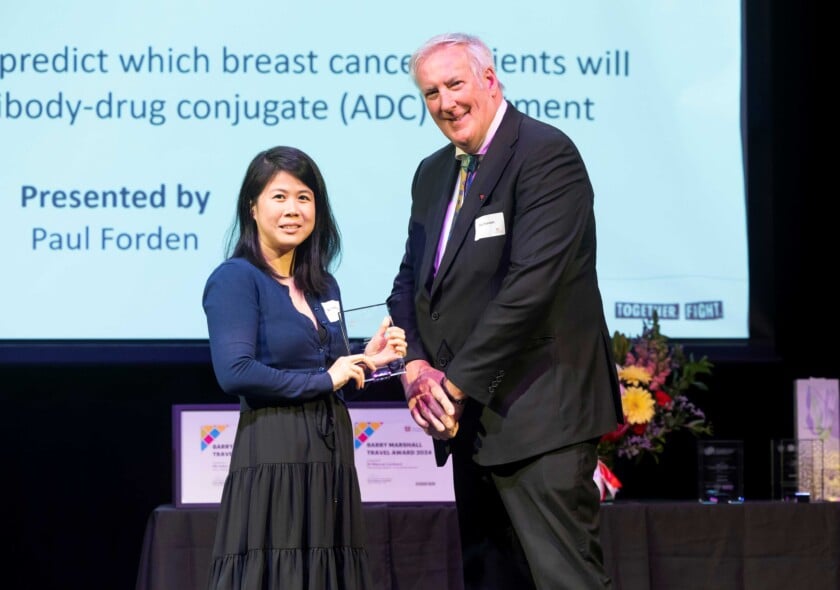
New research is looking at better ways to identify breast cancer patients who will benefit from a new type of cancer treatment.
Dr Trisha Khoo from Fiona Stanley Hospital received a grant to progress this important work through The Hospital Research Foundation Group, sponsored by SMHS Staff Giving.
Dr Khoo’s HAPPEN Project involves a new treatment type called an antibody-drug conjugate (ADC) which seeks out and kills cancer cells.
“(ADCs) can have huge benefits but sadly they just don’t work for some people,” she said.
“Currently we have no tests to tell who will benefit and who will not. This research aims to develop such tests and to learn why they sometimes fail so we can adjust them to work for everyone.”
Dr Khoo, like many women, has a personal connection to breast cancer and has always had a strong interest in research and treatments that may improve and save the lives of women affected.
“Although the treatment landscape for breast cancer is rapidly evolving, we still need to find better and more effective treatments, especially for those women who don’t respond to the standard treatments,” Dr Khoo said.
Dr Khoo said that ongoing support for medical research was critical to improve survival rates and involved a broad range of stakeholders from patients to professionals and clinicians and funders and that without ongoing support, advances in care would simply never happen.
“Funding for research is like the gift that keeps on giving – nothing is wasted even in trials that ultimately don’t work.”
Dr Khoo said the research being conducted as part of the HAPPEN Project was in two parts, the first of which is laboratory based, with the second requiring more active participation from current patients who are battling breast cancer. All patients enrolled in the study have been diagnosed with metastatic breast cancer.
Dr Khoo said more personalised, individually tailored treatments were proving to be the new frontier of treatment options and increased the options for those who don’t seem to respond to current or standard treatment regimes.
She said most of the tests being investigated in the research project do not require additional or specialist infrastructure and could rapidly be brought into trials or practice in laboratories and routine screening processes.
She said if successful they could also be applied to other cancers such as lung and gastric cancer.


