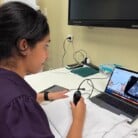
Peter Hastings has seen firsthand what dementia does to families.
His mother died with it. So did her brothers and father. And now, with early signs appearing in Peter’s own brain, he’s determined to change the story for the next generation.
Diagnosed with pre-clinical Alzheimer’s, Peter is part of an international clinical trial through the Queen Elizabeth Hospital, testing the drug lecanemab as a way to slow down the progression of Alzheimer’s.
He knows he may not receive the full benefit of the drug he’s helping to test – but that’s not why he’s doing it.
“I’ve seen the effect dementia has on loved ones,” the 70-year-old said.
“I don’t know if I’m on the placebo or not, it might not benefit me, but it might benefit my kids and my grandkids. They’re the ones I’m doing it for.”
Lecanemab is not yet approved for public use in Australia, only through clinical trials. But despite the research being in its infancy, Peter knows it’s a way to help his family – both in improving future treatments and hopefully delaying them witnessing his own decline.
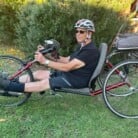
Peter originally wasn’t going to pursue the trial, being a busy volunteer in regional SA with wife Heather, but that all changed when the passionate team at the QEH’s Memory Trials Unit told him ‘10 years’.
“I asked ‘10 years until what?’ And they said, ‘10 years til you’re dead.’ So that got me moving.”
Peter has high levels of amyloid – a protein linked to cognitive decline in Alzheimer’s, which is what the drug targets.
“It effectively flushes the amyloids out of your brain,” he said.
“They say it’s not a cure, you can’t reverse it. But it apparently slows it down by about four years.
“There have been some possible side effects, I’ve had a couple of microbleeds and a suspected TIA (mini stroke) which turned out to be a silent migraine.
“But I’m in the very best care – they stopped the infusions immediately and I had a series of MRIs every two weeks for about six weeks to monitor it.”
Back on the drug or placebo now, every two weeks a nurse comes to Peter’s home to administer it as an infusion. And every 12 weeks he visits the QEH to have memory testing.
His blood samples and MRI scans are sent to labs in Japan, the US, Germany and England as part of the research – countries where lecanemab is approved for regular use.
When asked the age-old question about whether it’s better to know that you might decline, or be oblivious to it, Peter is matter of fact.
“After you’ve done all the tests, you kinda know. My short term memory was shot. The test looked easy but I couldn’t do it,” he said.
“It’s a wake-up call. And then you look at the trial and think, someone’s got to do it.”
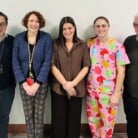
 Thanks to your donations, The Hospital Research Foundation Group is proud to be funding the QEH’s dementia research through our Dementia Fellow, awarded to Dr Chris Belder and supervised by Dr Cathy Short and Prof Tim Kleinig (right).
While lecanemab has not been approved for public use in Australia, another drug known as donanemab was approved by the Therapeutic Goods Administration and is now awaiting approval by the Pharmaceutical Benefits Scheme to make it more affordable for eligible patients.
To support more dementia research that has a real impact on people like Peter, donate today.