A new project funded by The Hospital Research Foundation Group is exploring how hospitals can better manage resources and prioritise care to reduce congestion and waiting times for patients.
Artificial intelligence (AI) will to be used to analyse data from de-identified electronic medical records within the Central Adelaide Local Health Network (CALHN), which includes the Royal Adelaide Hospital and The Queen Elizabeth Hospital, to find areas for improvement in operational flows.
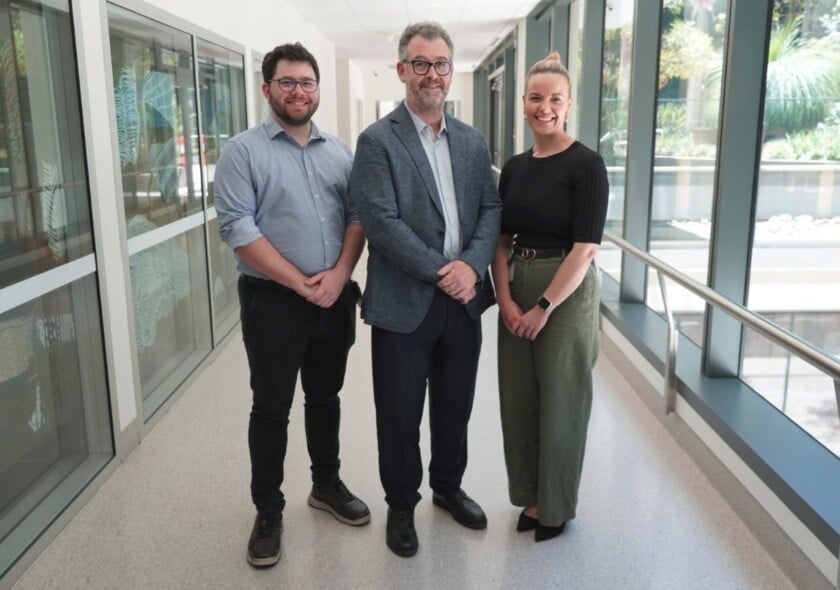
Led by Professor Gerry O’Callaghan (above centre), the research aims to understand how patients’ different needs – such as their diagnosis, severity of illness, complications and social circumstances – affect the demand for hospital resources.
“A major goal of the study is to develop models that help predict patient flow through the hospital and better quantify resource demand,” Prof O’Callaghan said, who is a Senior Consultant with the RAH’s Intensive Care Unit and Clinical Professor at the School of Public Health, University of Adelaide.
“With the rapid advancement of AI and machine learning, we can use these tools to analyse the de-identified electronic medical records and better understand how resources can be allocated and actions prioritised to decrease hospital congestion and waiting times.”
The unpredictable nature of patient arrivals and the time needed to discharge patients are some of the biggest challenges when managing hospital flows.
To address this, the project proposes to group patients into more specific streams such as Acute Ambulatory, Specialty Pathways, Sick/Frail/Elderly, and Hyper Complex/Multi-organ Failure.
“By focusing on these streams, we hope teams can improve the allocation of resources, create more efficient care models, and streamline hospital operations,” Prof O’Callaghan said.
“We will work closely with healthcare teams to validate these models and implement them in real-world settings, especially with a focus on improving outcomes for patients who are currently disadvantaged by the system.”
The three-year project, also driven by Clinical Project Officer Madison Bills and Registered Nurse Matthew Williams (both right), aims to create practical tools and guidelines for hospital administrators to use in their daily operations, ensuring that changes are implemented quickly and can be adopted at a larger scale.
The research-driven findings are likely to not only help CALHN, but healthcare networks nationally improve emergency department congestion, ambulance ramping, and long waiting times for care.